Helping Independent Practices Remain 'Independent'
Healthcare Reimbursement Consulting and Appeals
Turn Payer Tactics into Recovered and Protected Revenue
Denials • Underpayments • Audits • Recoupments

Reimbursement Defense for Solo and Small Independent Practices
MedClaim Alliance was created specifically for solo and small independent practices to help level the playing field against payer tactics that threaten the revenue they have worked hard to earn. We provide the reimbursement defense strategies and appeals that practices need to challenge improper payer actions, recover unpaid revenue, and protect the money they have already earned.
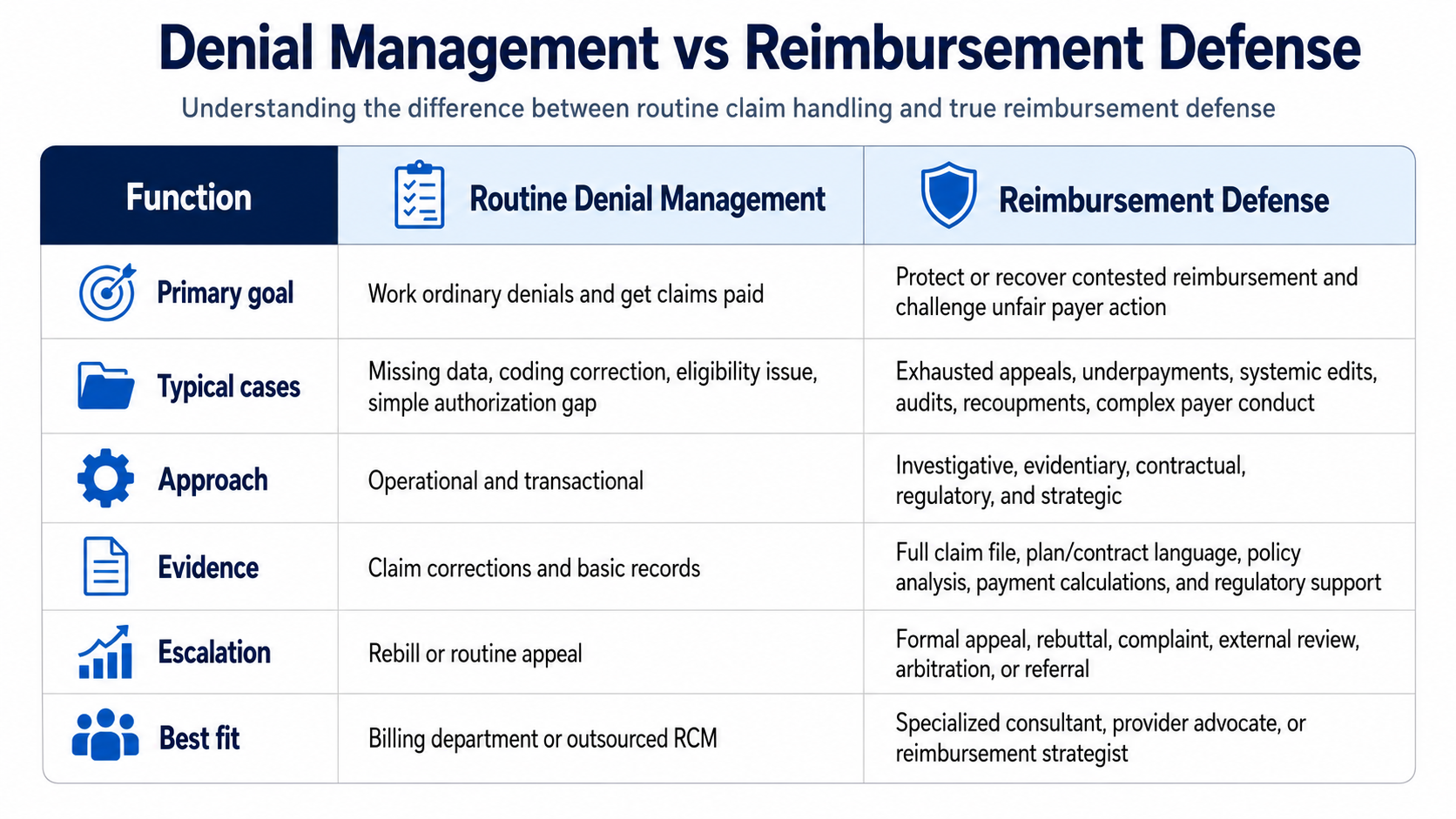
Your billing team may handle routine denials just fine. But when a payer launches a large-scale recoupment audit, demands repayment on multiple claims, upholds wrongful denials, or systematically underpays your claims, standard appeals often fall short. You need reimbursement defense, not another routine appeal. Reimbursement defense goes beyond routine denial management by examining the basis for the payer's decision, identifying unsupported reasoning or improper reimbursement practices, and challenging them under the applicable coverage terms, governing provisions, and regulatory requirements. This creates a stronger, case-specific strategy to pursue any payment owed and protect earned revenue from improper recoupments.
Choose Your Level of Support
You choose the level of support that fits your practice. For a flat fee, we can provide you with written reimbursement consulting or build a customized, ready-to-submit appeal or dispute package. If you prefer a hands-off approach, we can also manage the recovery process for you on a contingency-fee basis, from initial strategy through payer follow-up and resolution.
Keep More of What You Recover
Let's say your practice has $10,000 in denied claims from a payer. If you hire a traditional revenue recovery vendor that charges a $30% contingency fee, the vendor receives $3,000 from the recovery, leaving your practice with $7,000. Under our flat-fee model, you might pay $450 for us to analyze the dispute, identify the payer tactic, determine the governing requirements, and develop the reimbursement defense strategy needed to challenge it.
When you recover the full $10,000 using our strategy-driven reimbursement defense, we don't take any percentage of your recovery. After our $450 flat fee, your practice has $9,550 in additional revenue, compared to $7,000 under the other vendor's model. That's an additional $2,550 staying where it belongs—with your practice.
But the bigger advantage comes afterward. If the same payer tactic continues affecting other claims that are governed by the same rules, you may be able to apply that same reimbursement defense to those claims as well. Instead of continuing to give up a percentage of every recovery, you now have a strategy you can use to challenge the underlying reimbursement issue from now on.

When Routine Denial Management Is No Longer Enough
Standard appeals rarely solve difficult or complex reimbursement disputes. When a payer keeps denying payment, questions your records in an audit, or demands money back, you need a response that addresses the reason behind its decision.
MedClaim Alliance gives independent providers and their billing teams specialized backup for those disputes. We examine the payer's position, review the supporting documents, and build a case-specific response grounded in the applicable coverage terms, contract provisions, and regulatory requirements. From complex appeals and underpayment disputes to audit support and recoupment defense, our focus is on pursuing the payment you're owed and protecting earned revenue from unsupported demands.
You don't have to accept the payer's explanation at face value. We help you identify where the payer's decision can be challenged and submit a well-supported response that uses applicable regulatory requirements to hold the payer accountable.
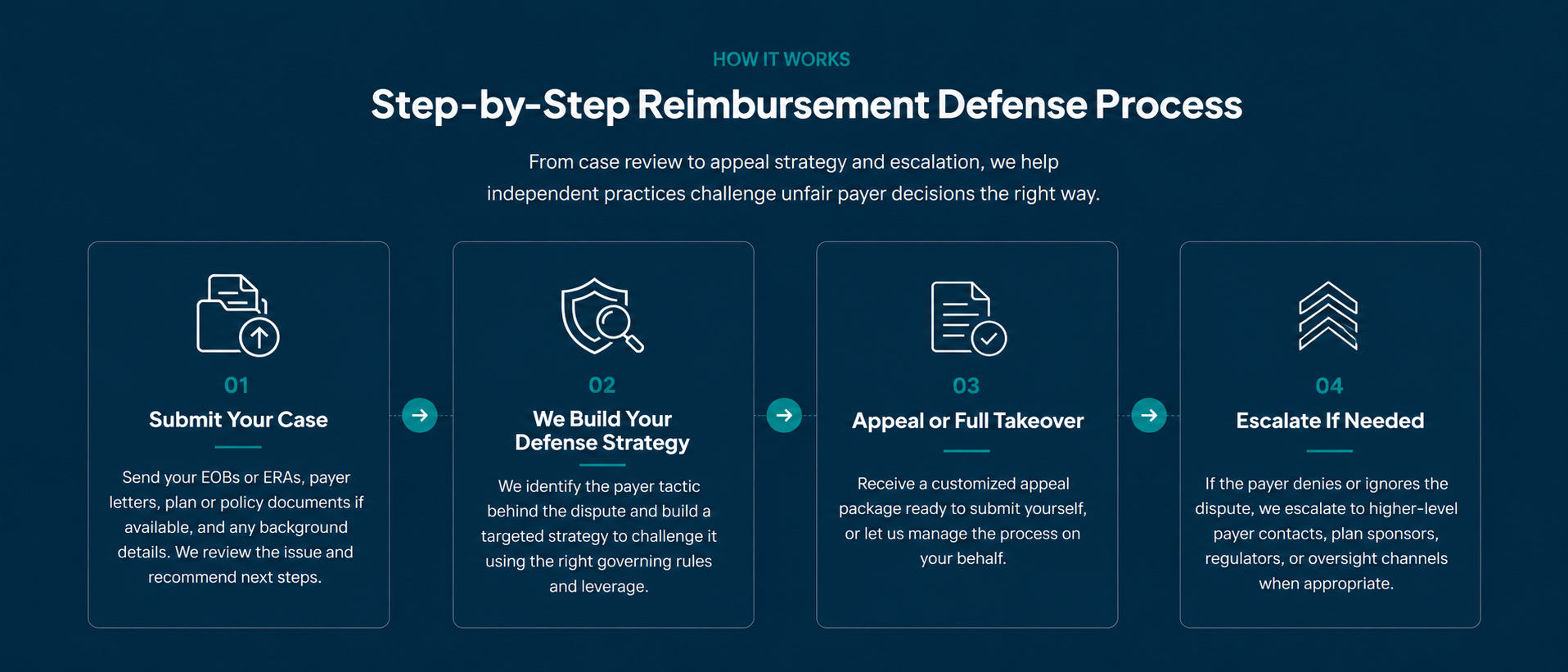
We analyze the specific reimbursement dispute, identify the strongest administrative path, and deliver to you a ready-to-submit appeal, dispute package, or regulatory complaint built for complex cases—so your practice can recover earned revenue and keep it.
MedClaim Alliance provides reimbursement consulting, claims analysis, appeal development, and administrative advocacy support. We do not provide legal advice or legal representation. Matters involving litigation, alleged fraud, government investigations, subpoenas, or significant compliance exposure should be evaluated by qualified healthcare legal counsel.
Real Results from Real Clients
$50,000 in underpayments recovered. A small clinic thought these underpayments were uncollectible. We challenged the payer's payment policies and the provider recovered full reimbursements, enabling them to cover three months of overhead.
$60,000+ recoupment demand withdrawn. A two-provider group practice faced aggressive clawbacks. We prepared a case-specific defense package challenging the payer's demand. The payer withdrew the demand in full. The practice kept every dollar and avoided a cash-flow hit that would have forced hard choices.
$20,000+ in offsets reversed for a solo PT. We challenged the offsets with the right leverage, and the recoupments were fully reversed. Money that had been taken came back and stayed in the practice.
$15,000+ in silent PPO discounts recovered. We challenged the discounts and recovered meaningful amounts across multiple claims. The provider finally felt like he didn't have to accept whatever the payer decided.
(These are just a few examples. Every case is unique.)
Recover What's Yours. Protect What You've Earned.

Who We Serve

Solo Practices
Solo practitioners who want to stay independent and profitable.

Small Group Practices
Specialty practices in chiro, PT, surgery, orthopedics, etc., facing challenging denials, underpayments, audits and recoupments.

Medical Billers
Independent billers who need some specialized help with challenging payer tactics and requiring payer accountability.
Our Services — Two Ways to Fight Back
Choose the level of support that fits your case. We offer a flat-fee package that you submit yourself or contingency-based recovery that we manage for you.
Stay in Control and Keep 100% of What's Recovered
We identify the payer's tactic, build the entire defense strategy, draft the appeal, and plan the escalation if needed — for a flat fee quoted specifically to your case, not a percentage of the outcome. You submit it yourself, stay in control of the dispute process, and keep everything you win.
Contingency Based
Done-for-You Recovery
We can take over the case entirely, and you pay nothing unless we recover revenue for you. Every case is scoped individually, with rates built to stay fair for small independent practices.
Send us your case.
We'll review it, tell you what we see, and recommend a clear next step. If it's worth fighting, we'll show you exactly how.
